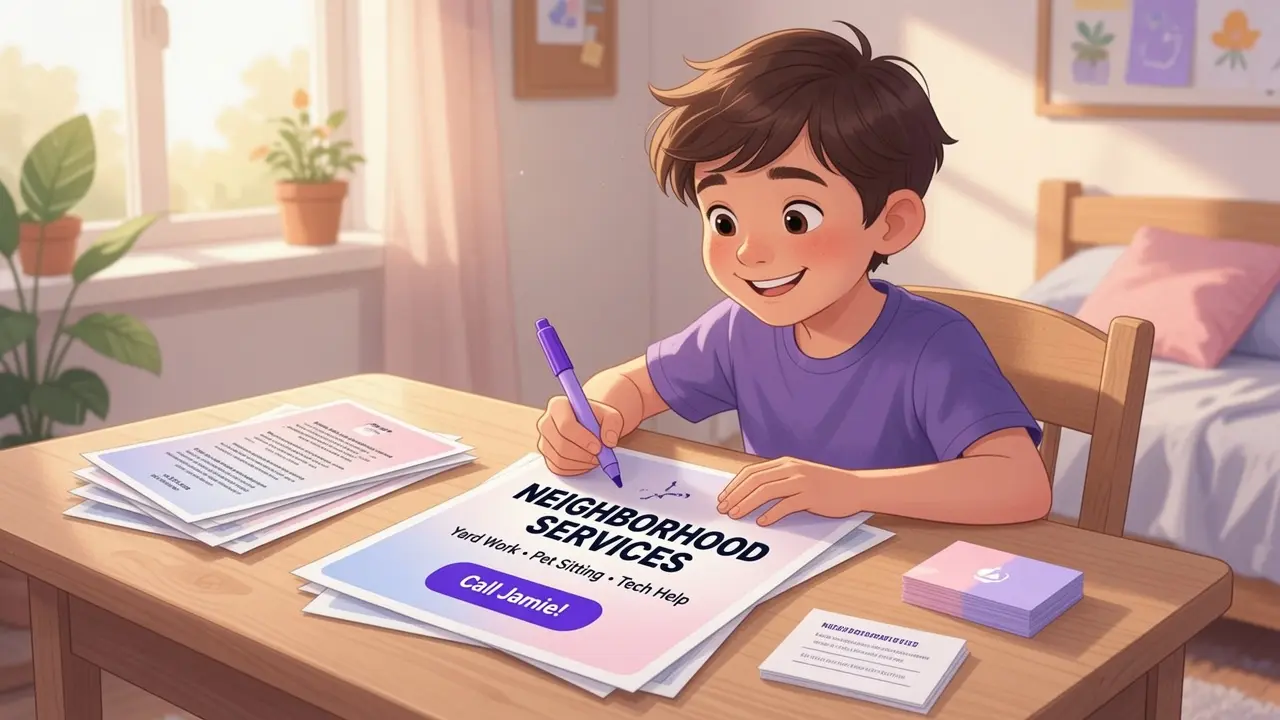

Helping Your 5th Grader Start a Summer Business
Moving from Passive Consumption to Active Contribution
At the age of 10 or 11, a 5th grader is at a unique developmental crossroads. They possess sufficient reading, writing, and basic mathematical skills to manage simple logistics, yet they still require significant adult oversight regarding safety, commitment management, and interpersonal ethics. When a child expresses interest in a neighborhood side hustle or a digital service, it offers a practical context for learning cause and effect that school environments rarely provide.
Assessing Feasibility and Scope
The first step is helping your child differentiate between a hobby and a service. A hobby is done for personal enjoyment. A service requires that someone else receives value in exchange for a fee or trade. Discuss what services are actually feasible for a 5th grader. Common options include neighborhood pet sitting, plant watering, or digital tasks like helping neighbors set up simple smart home devices. Avoid business models that involve excessive travel or unsupervised interactions with strangers.
Setting Realistic Financial Expectations
Many 5th graders view money as an abstract reward rather than a result of value exchange. Use this project to bridge that gap. Create a simple ledger. If your child intends to offer pet sitting, help them calculate the cost of supplies, such as bags or treats, and subtract these from their projected earnings. This makes the concept of overhead concrete. If they are earning five dollars for a visit, help them document the time spent and the actual profit realized. This prevents the disappointment that occurs when a child expects high returns for minimal or irregular effort.
Managing Time and Commitments
One of the most significant challenges for a 5th grader is the transition from a highly scheduled school day to the unstructured nature of summer. A business provides a framework for self-regulation. If your child commits to watering a neighbor's plants, explain that the neighbor relies on that promise. Use a physical calendar on the refrigerator rather than a digital app. A physical visual aid helps an 11-year-old track their obligations and anticipate conflicts, such as family vacations or summer camps.
Handling Obstacles and Failures
Disagreements with clients or logistical failures are inevitable. If a neighbor cancels or a client is dissatisfied, avoid the temptation to solve the problem for your child. Instead, walk them through the logic. Ask questions such as: What part of the service did not meet the agreement? How could you change your process to prevent this next time? This shifts the focus from the negative emotion of the failure to the mechanical solution of the problem. Your role is that of a consultant, not the primary operator.
Balancing Safety and Independence
Safety remains the paramount concern. For any physical service, limit activities to neighbors you know well. For any digital activity, you must maintain oversight of communication. If your child is offering a digital service like helping an elderly neighbor organize photos on a tablet, accompany them or ensure the interaction occurs in a common area of the home. Establish a rule that all client communications must be visible to you before they are sent.
Concluding the Business Cycle
At the end of the summer, conduct a project review. Look at the ledger together. Discuss what was difficult, what was easy, and what was surprising. If the business was successful, they might choose to continue in a limited capacity during the school year. If it was difficult, they have learned that some forms of work are less appealing than they initially assumed. Both outcomes provide valuable data for their personal growth. By framing this experience as a process of discovery rather than a measure of success, you provide a stable foundation for them to take on more complex challenges in the future.