
Backyard Physics and Engineering for a 3rd Grader
Science in the Backyard
Third grade is a pivotal time for scientific development. Children are moving from simple observation to structured experimentation. They can begin to hypothesize, design tests, and analyze results. Summer offers a unique opportunity to apply these skills through backyard physics and engineering projects that turn natural curiosity into a structured understanding of how the world functions.
The Engineering Design Process
Engineering is essentially a game of problem solving. By 3rd grade, your child can handle the formal steps of the engineering design process: identify a problem, brainstorm a solution, build a prototype, test it, and refine based on data. When you initiate a project, encourage your child to start with sketches rather than just materials. This forces them to organize their intent before physical construction.
Bridge Building Challenges
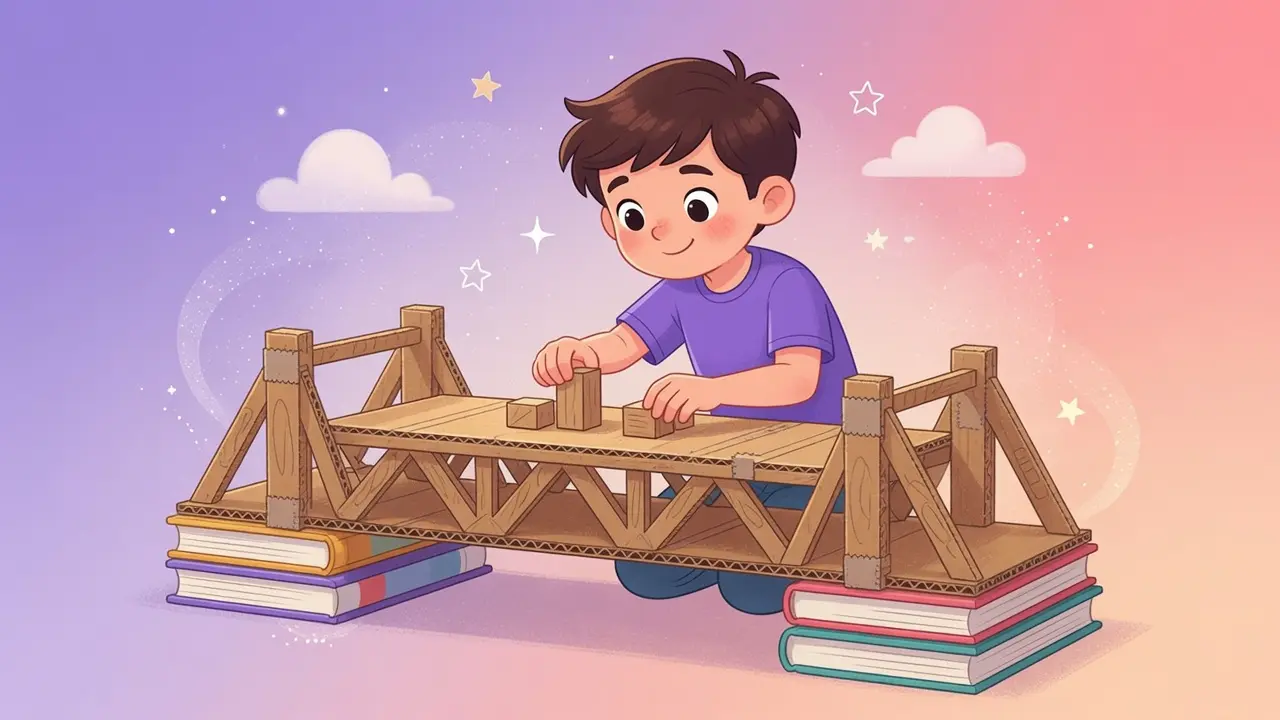
Challenge your child to build a bridge between two chairs that can support a specific weight, such as a stack of books. Require them to use only specific materials like cardboard, tape, and string. After the first attempt, regardless of whether it fails or succeeds, analyze the structural points of failure. This teaches them to view failure as a technical data point rather than a moral outcome.
Ask them to test a different structural design, perhaps a truss system, and compare the weight capacity. By keeping a log of the capacity of each design, they gain a tangible understanding of structural physics and the importance of data-driven iteration.
Backyard Physics Experiments
Physics at this age should be focused on observable phenomena: force, motion, energy, and gravity. Keep your experiments focused on single variables to ensure the lessons are clear and testable.
Ramp and Motion Studies
Using a board and various objects, marbles, wooden blocks, toy cars, you can explore how mass and incline affect motion. Set up a simple ramp and challenge your child to predict which object will reach the finish line first. After testing, have them change the angle of the incline and record how that alters the results.
Ask them to hypothesize why a heavier object might behave differently than a lighter one under specific conditions. By manually testing these physical variables, they develop an intuitive grasp of kinetic energy and gravity.
Collaborative Problem Solving
When a design fails, avoid providing the solution. Instead, ask questions that force the child to evaluate their construction. Ask what they notice about where the structure bent or broke. Ask what they might change if they were given one additional material. This shifts the focus to collaborative problem solving where the parent acts as a guide for inquiry.
If they are building a water-powered system, focus on how pressure and gravity work together. If they are constructing a device to protect an egg during a drop, focus on how force is distributed across the casing. These real-world applications make abstract concepts concrete and understandable.
Documenting and Reflecting
Scientific inquiry is incomplete without documentation. Ensure your child keeps a simple notebook where they sketch their designs, list the materials used, and summarize the result of every test. This journal becomes a record of their progress and a reference point for future experiments.
After a few days, review the journal together. Identify patterns in their designs that led to success. This reflective practice bridges the gap between doing the work and understanding the underlying principles. By treating backyard physics as a serious intellectual pursuit, you help your child enter the next school year with a more robust capacity for critical inquiry and structural reasoning.