
Stop 7th Grader Math Slide Without Worksheets
Rethinking Summer Math Maintenance
Many parents worry about their 7th grader losing academic progress during the summer months. The transition from 7th to 8th grade is a critical period where foundational algebra and geometry concepts are solidified. Relying on repetitive worksheets often creates a negative association with mathematics, leading to resistance and burnout. Instead, parents can foster mathematical fluency by integrating practical challenges into everyday summer activities. This approach treats math as a tool for solving real-world problems rather than an abstract set of rules to memorize.
The Kitchen as a Laboratory for Ratios and Scale
Cooking provides immediate, tangible opportunities to practice ratio, proportion, and unit conversion. A 7th grader possesses the cognitive capacity to manage complex modifications to recipes. Ask your child to scale a recipe for a dinner party or a family gathering. If a recipe serves four people but you need to accommodate twelve, your child must calculate the scaling factor and adjust each ingredient measurement accordingly.
This task requires converting fractions and decimals, often involving mixed units like cups, tablespoons, and teaspoons. Encourage your child to double-check their calculations before proceeding. If they suggest adding six cups of a specific spice because they failed to convert the teaspoon measurement, discuss the mathematical error and the potential consequence for the final product. This builds an understanding of why precision matters in a way that worksheet problems simply cannot replicate.
Home Improvement and Geometric Reasoning
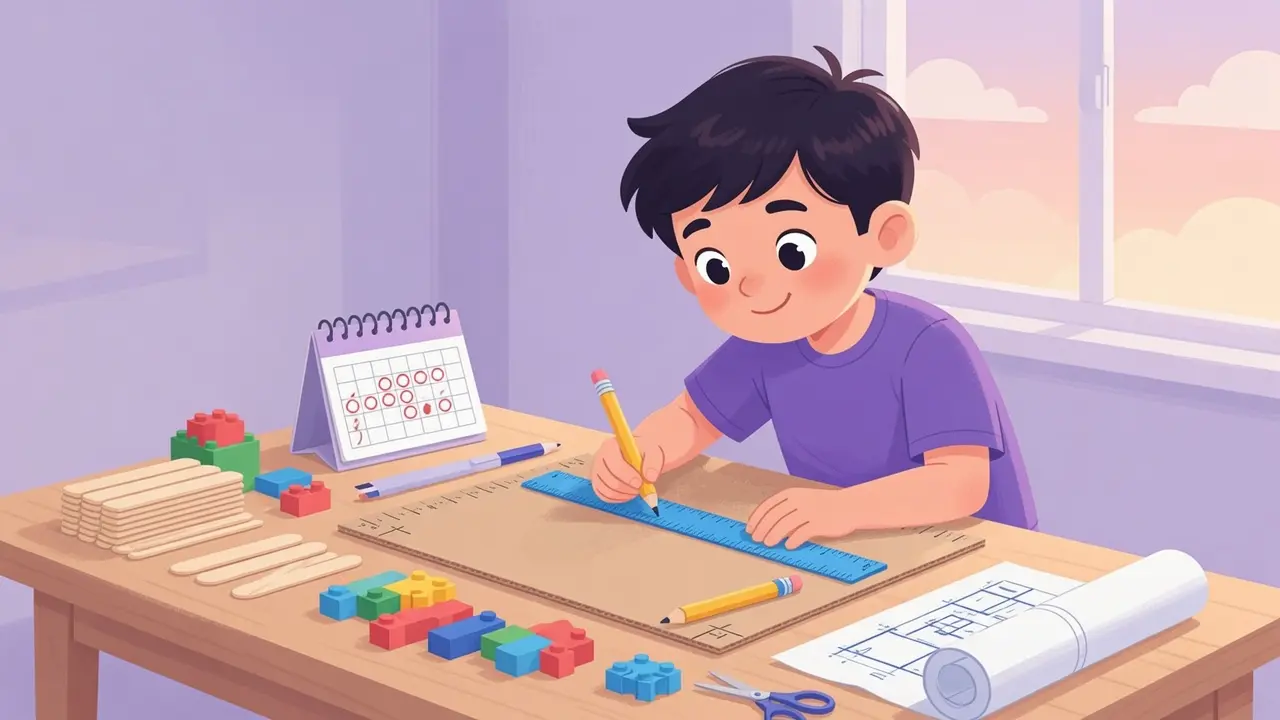
Summertime often brings projects like painting a room, building a raised garden bed, or organizing a garage. These tasks offer excellent chances to apply geometric concepts. When planning to paint a wall, ask your child to calculate the total surface area, accounting for windows and doors that will not be painted. If you are building a garden box, have them design the frame based on specific board lengths, calculating the volume of soil required to fill the container.
These activities require students to think spatially. They must visualize the project and identify which measurements are necessary for success. If your child miscalculates the area of a room, the consequence is a trip back to the store for more paint or wasted materials. This natural consequence is a powerful teacher. It shifts the burden of accuracy from the parent to the student, fostering a sense of ownership over the project and the math used to complete it.
Personal Finance and Budget Planning
By age thirteen, most students are capable of managing a small budget. Use your summer travel plans or weekly grocery shopping to teach the principles of unit pricing and percentage calculations. Before heading to the grocery store, provide a set budget and a shopping list. Ask your child to estimate the total cost of items. While in the store, have them compare unit prices for bulk items versus smaller packages.
If you are planning a road trip, involve your child in calculating the estimated cost of fuel. Provide them with the distance of the trip, the fuel efficiency of your vehicle, and the current average cost of gasoline. They must calculate the total gallons needed and the projected expense. If you plan to eat out during the trip, ask them to determine the tip amount based on different percentages. These activities move math from the classroom to the real world, showing students how algebraic thinking serves as a foundational skill for independent adult life.
Encouraging Critical Evaluation of Data
Mathematics is not just about calculation; it is about interpreting data. Encourage your child to examine infographics or charts in news articles or sports statistics. Ask them to identify what the data represents and whether the visual representation matches the numerical values. If a chart uses a truncated axis to exaggerate differences between two values, ask your child to identify why this might be misleading. This exercise develops critical thinking skills and prepares students for higher-level statistics courses in high school.
Creating a Collaborative Environment
Success in maintaining math skills over the summer depends on shifting the role of the parent from instructor to facilitator. Avoid checking their work for them. If a calculation results in an outcome that does not make sense, ask them to retrace their steps and explain their logic. Use questions like, How did you arrive at that conclusion, or What impact does this measurement have on the final result?
By focusing on the reasoning process, you help your child develop the confidence to navigate complex mathematical problems independently. Summer should be a time for rest, but it can also be a time to apply learning in ways that are relevant, meaningful, and effective. By moving away from workbooks and toward real-world applications, you help your 7th grader bridge the gap between abstract concepts and practical utility, ensuring they are well-prepared for the challenges of 8th grade and beyond.